
Why Content and Marketing Silos Hurt Performance (And How to Fix It)

For years, many organizations — especially associations — have operated under a kind of unspoken rule: Editorial and marketing don’t mix.
Content teams focus on the magazine, the journal, maybe a blog if there’s time. Marketing handles campaigns, lead generation, and promotion.
It’s a classic “church and state” setup, and for a while, it worked.
But today’s audience doesn’t experience your organization in silos.
And in a marketing landscape defined by AI, fragmented channels, and zero-click behavior, that separation is more than just outdated. It’s a risk.
The Hidden B2B Buyer
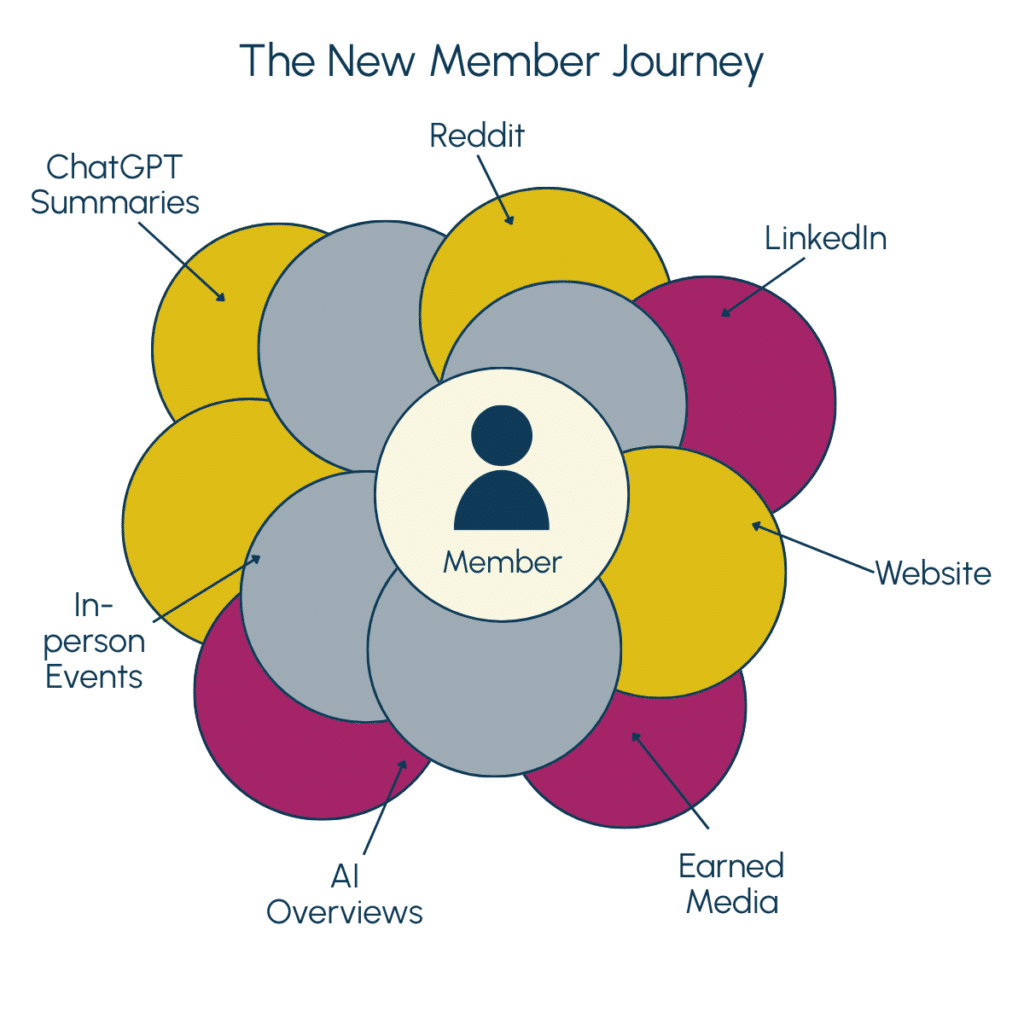
The reality is, your audience is doing their homework without you. By the time a potential member, customer, or partner raises their hand, they’re already 60–70% through their decision-making process — researching, comparing, and forming opinions long before y
ou ever capture their information.
A lot of that journey is completely invisible.
Your audience is:
- Asking peers
- Reading content on LinkedIn or Reddit
- Listening to podcasts
- Prompting AI tools for answers
What didn’t make the list: clicks, form fills, and attribution trail.
If your organization isn’t showing up during that phase, you’re losing leads before you even knew they existed.
The Zero-click Shift Is Here
For years, we built strategies around a predictable journey:
Search → Click → Landing Page → Download → Email Nurture
To be fair, that model still exists. But it’s no longer the dominant path.
Today’s journey is fragmented, nonlinear, and increasingly zero-click — meaning your audience gets what they need without ever visiting your site.
That’s leading to a bigger shift: Value has to show up where your audience already is, not where you want them to go.
In this environment, trust is the only currency that converts.
And trust doesn’t come from gated content, product-heavy messaging, or one-off campaigns. It comes from consistently showing up with useful, credible, thought leadership content — before your audience ever raises their hand.
Teams Are Structured for a World That No Longer Exists
When organizations operate with a “church and state” divide — content separate from marketing — it creates fragmentation.
While those teams are optimizing within their own lanes, your audience is experiencing everything as one continuous journey.
When those internal functions aren’t aligned, the cracks start to show:
- Messaging feels inconsistent from channel to channel
- Teams unknowingly duplicate work or compete for attention
- Valuable content gets underutilized or buried
In a landscape where attention is limited and trust is hard-earned, disconnected efforts slow you down and make you easier to ignore.
The Shift to a Content Ecosystem
The organizations getting this right aren’t producing more content. They’re producing connected content.
They’ve made a fundamental shift, from siloed teams to a unified content marketing engine.
In this model:
- Content becomes the central nervous system of marketing
- Editorial insight fuels every channel
- Marketing amplifies and distributes that insight
- Data informs what happens next
Editorial and marketing work together in one world: Content is the fuel. Marketing is the engine.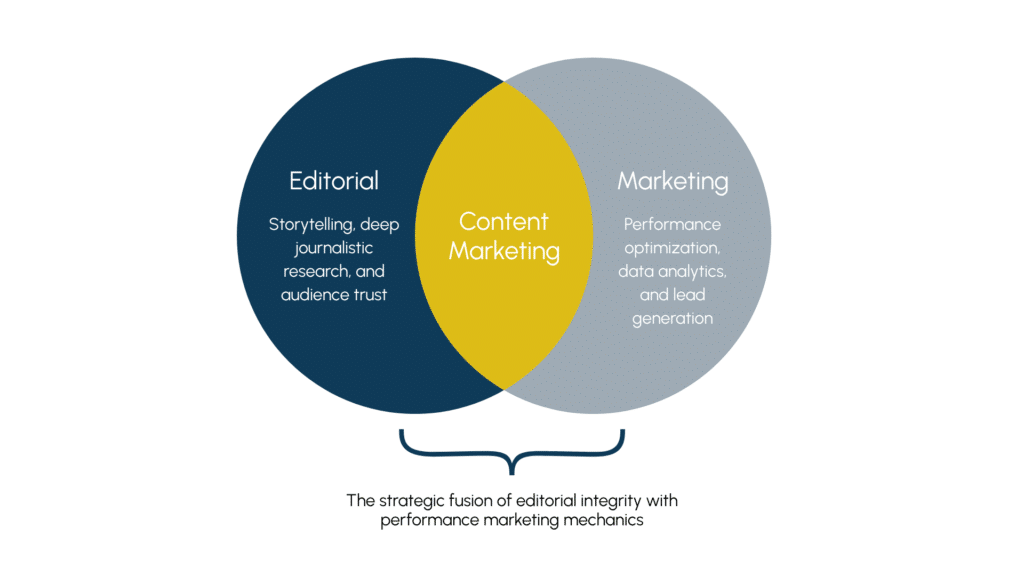
This shift also requires a new kind of leader. The traditional editor-in-chief role — focused on managing a publication — is evolving into something much bigger: a content strategist.
This critical role is responsible for:
- Spotting industry trends
- Shaping the narrative
- Connecting departments
- Using data to guide decisions
- Identifying new content opportunities
Rather than just creating content, they’re orchestrating the content marketing system.
Blueprint to Start Creating Smarter Content
Here’s how to put this into practice:
1. Start With Signals — Not Assumptions
Turn “magazine issue planning” into ongoing omni-channel, cross-department content planning. Use a layered approach to guide what stories get told:
- Behavioral data
- Member feedback
- Industry trends
- AI insights
2. Build One Strong Macro Narrative
Instead of creating dozens of disconnected content pieces, invest in one authoritative piece:
- Original research
- A deep-dive feature
- A long-form story
This becomes the foundation for everything else.
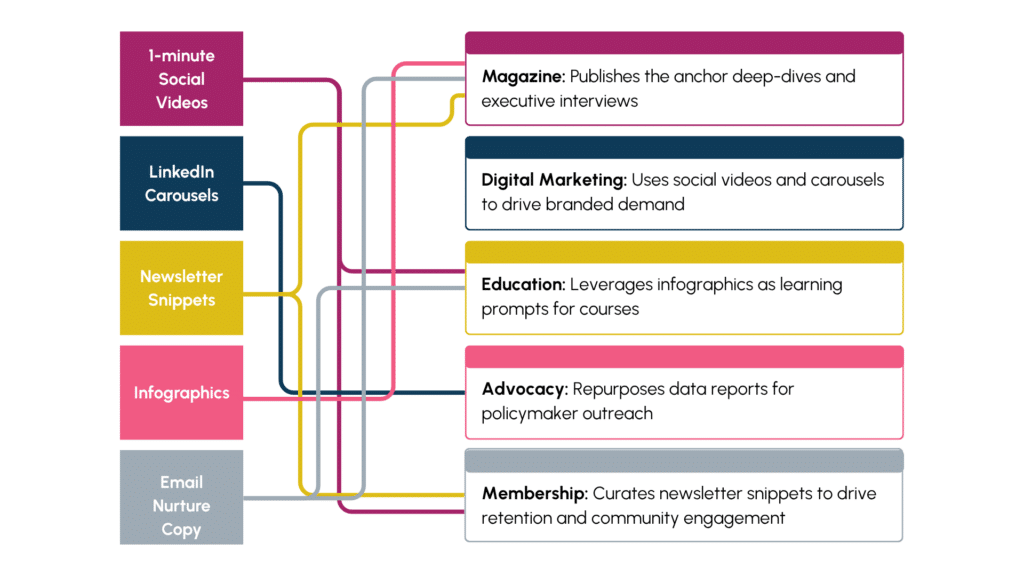
3. Multiply It Across Channels
From that one piece, create any number of bite-sized assets for a variety of uses:
- Social posts
- Infographics
- Webinars
- Email content
- Video snippets
4. Distribute With Intention
Make plans to leverage the content across distribution channels and departments:
- Into newsletters
- Onto LinkedIn
- Into education programs
- Across advocacy and membership communications

5. Close the Loop With Real Measurement
When content is coordinated across channels and teams, measurement gets a lot more useful. You’re no longer relying on an annual reader survey or isolated campaign reports.
Instead, you’re pulling in real data from across your ecosystem — email performance, social engagement, website behavior, event insights — all of it working together to give you a clearer picture of what’s actually resonating.
That changes how you plan. Instead of guessing what your audience cares about or defaulting to the same content cycles, you’re using real signals to guide decisions. You can see what topics are gaining traction, what formats are performing, and where engagement is dropping off — and adjust in real time. Measurement stops being a retrospective exercise and becomes part of the system, feeding directly back into smarter, more connected content planning.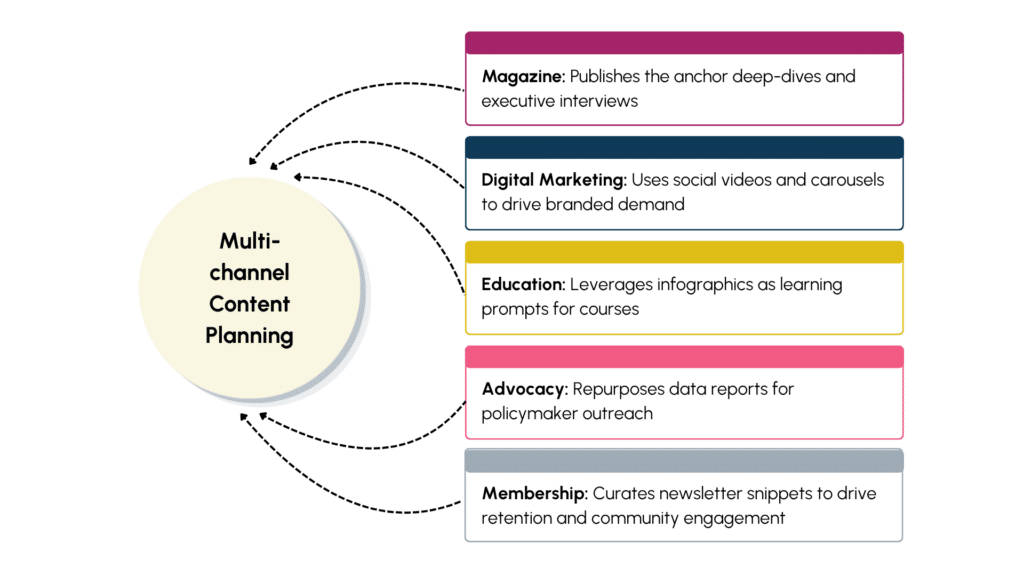
Where This Leaves You
You’re at a crossroads if your organization still:
- Plans content by channel
- Measures success in silos
- Separates editorial from marketing
The organizations that win in this environment won’t be the ones producing the most content. They’ll be the ones who:
- Align their teams
- Build around a central narrative
- Show up early in the buyer journey
- Earn trust before the click
For many organizations, that means rethinking how teams actually work together.

Content Strategy vs. Content Marketing
Content strategy and content marketing. You no doubt have heard of them and know that each is essential to helping…

The 7 Steps to Plan a Content Strategy
Your blog started with good intentions. Boost SEO, check. Get more engagement, check. But somewhere along the way, things got…
Which Content Marketing Solutions Are Right for You?
The biggest difference between content marketing and marketing? Content marketing’s focus on storytelling to connect, educate, and motivate through value,…

How to Create a Content Marketing Framework [With Templates]
Ever feel like your content marketing is a chaotic free-for-all? You need a content marketing framework. Think of it as…
How to Use AI to Build Smarter Audience Personas in Minutes (Not Days)
As content strategists, we all know the value of audience personas — those detailed profiles that help bring your target…

How to Build a Custom Editorial Chatbot in 4 Easy Steps
You’re deep into your workday, juggling meetings, content reviews, and deadlines when a writer pings you with a question about…

Marketing Funnels Are Out. Touchpoints Are In.
For decades, the marketing funnel has been the North Star for marketers — a simple, linear framework to guide potential…

What B2B SaaS Brands Can Learn from Consumer Brands
At BackPocket, we work with a wide range of organizations, including nonprofits, associations, and small businesses. Among them, one subset…

Top Ten Content Marketing Resolutions for 2025
As we step into 2025, the content marketing landscape continues to evolve, presenting new challenges and opportunities. To thrive in…

7 Fitness-Inspired Content Strategy Takeaways from CM World
What does fitness have to do with content strategy? As a busy mom of two, balancing family, work, and personal…
- « Previous
- 1
- 2
- 3
- 4
- Next »